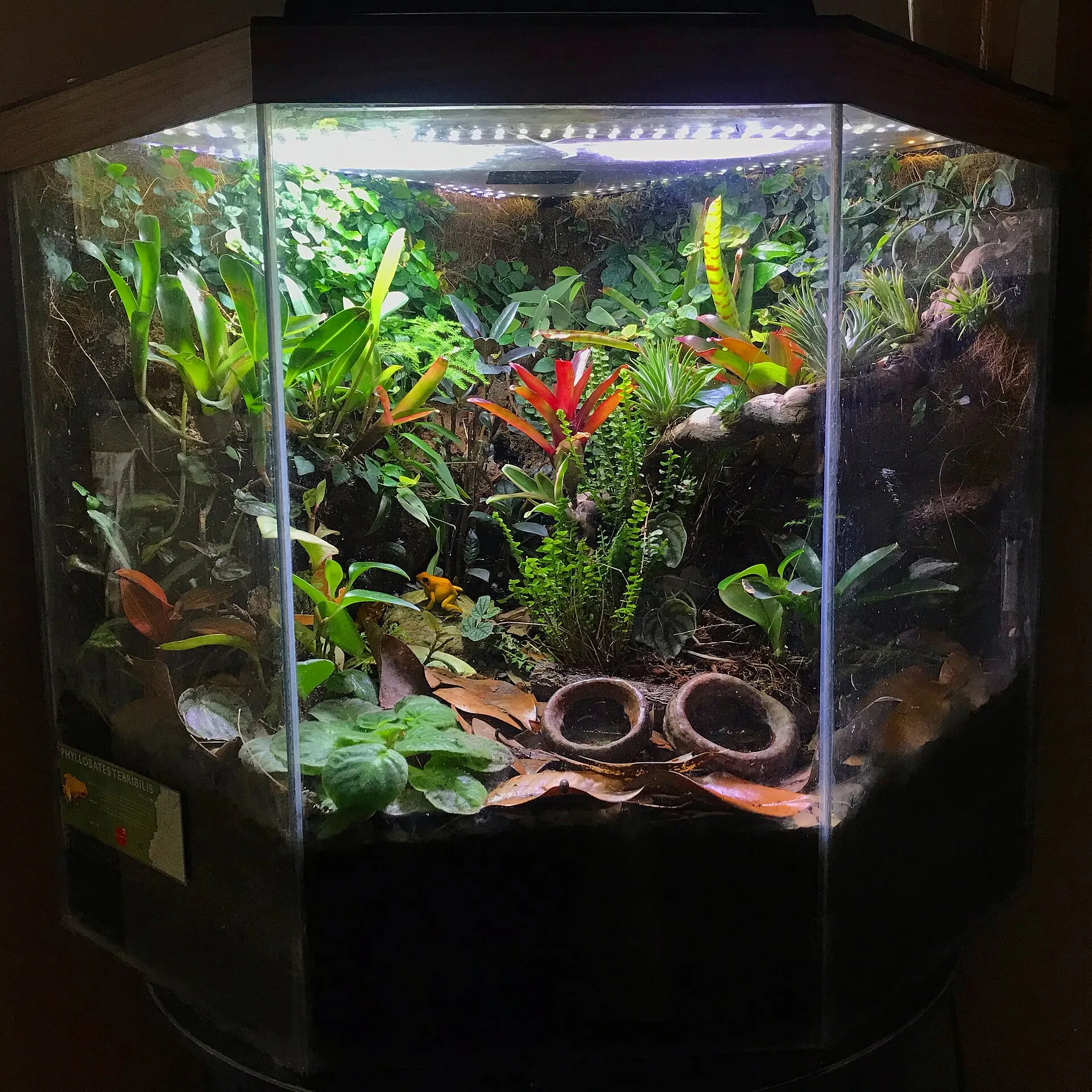
Do You Have to Clean a Bioactive Terrarium?
What the cleanup crew handles in a bioactive terrarium and what you still have to do yourself: spot cleaning, urates, glass, pruning, leaf litter, misting and the rare substrate refresh.
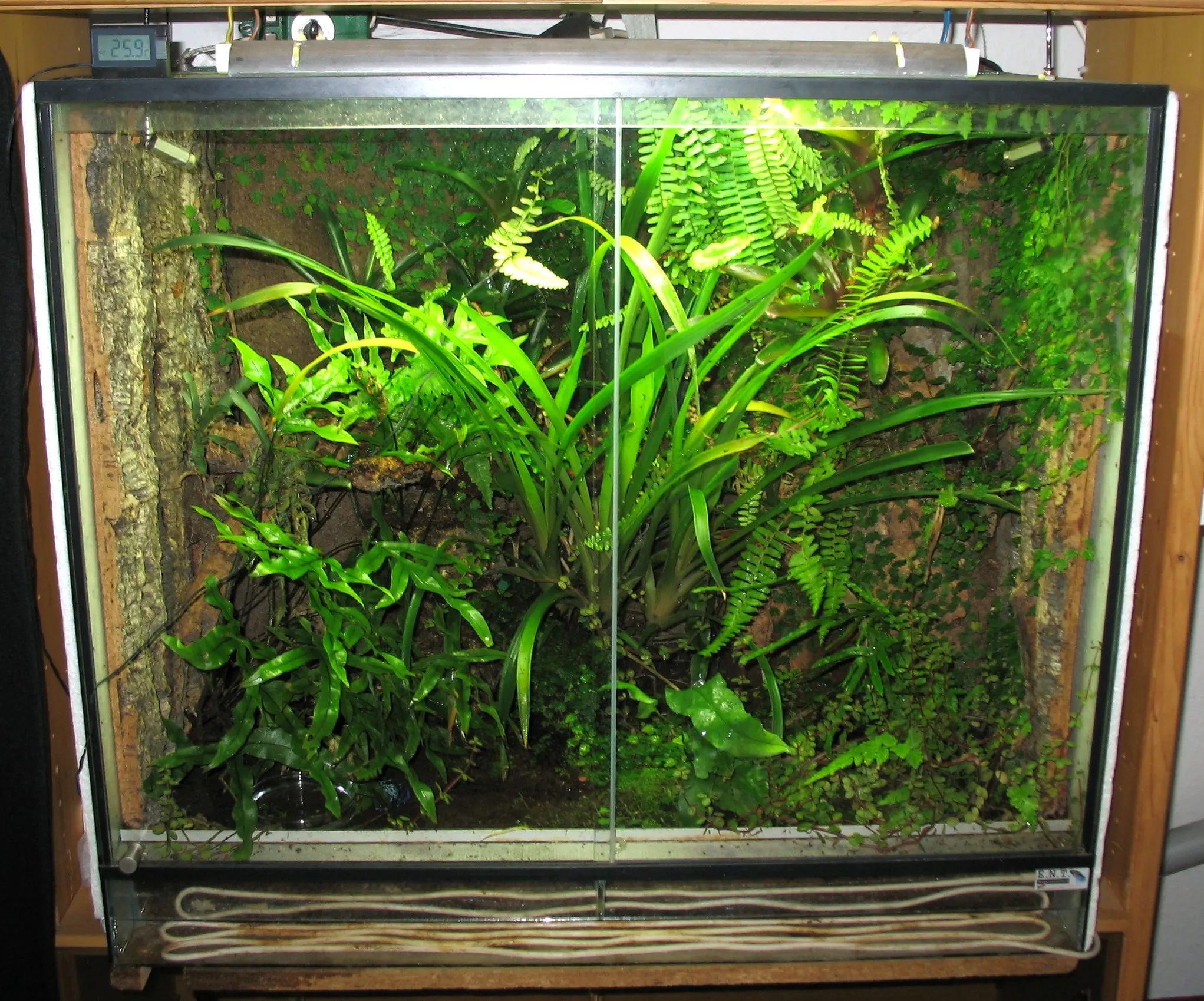 Photo: Rolf Kolasch, CC BY-SA 2.5
In this guide
Short answer: yes, but much less than a standard enclosure. Isopods and springtails break down small droppings, shed skin, dead leaves and mold, so you don’t strip and disinfect the whole tank. You still spot clean large waste and urates, remove uneaten food, wipe the glass, prune plants, top up leaf litter and keep moisture right. A full substrate change is rarely needed in a healthy setup. Zen Habitats puts it simply: bioactive is “low-maintenance, not no-maintenance.”
What the cleanup crew does (and doesn’t do)
| Job | Cleanup crew | You |
|---|---|---|
| Small droppings | Breaks them down over time | Remove large piles, especially in small tanks |
| Urates (the white, chalky part) | Not broken down, per The Bio Dude | Pick them out |
| Leftover feeder insects and food | Eats some | Remove what’s left before it molds |
| Shed skin | Usually eaten | Nothing, unless it’s large |
| Mold on wood and leftovers | Springtails graze it | Remove large or persistent patches |
| Dead leaves and plant debris | Main food source | Add more litter as it disappears |
| Glass, water spots, algae | Nothing | Wipe it |
| Overgrown plants | Nothing | Prune |
| Water dish | Nothing | Clean and refill |
The crew is a decomposer team, not a janitor. It works at its own pace, and a large reptile can produce waste faster than a small colony can process it. Zen Habitats notes that spot cleaning stays essential for species with high-odor or high-moisture waste.
A simple maintenance schedule
Sources give few fixed intervals, so treat these as starting points and adjust to your animal and enclosure.
| How often | Task |
|---|---|
| Daily or every other day | Look for large droppings, urates and dead feeders; clean and refill the water dish |
| As needed (daily to weekly) | Mist or water to keep the humidity your animal needs |
| Weekly | Check that the crew is visible under litter and bark; offer a little crew food if needed |
| Every few weeks | Wipe the glass; check the drainage layer water level |
| Monthly | Check plants and trim fast growers (Josh’s Frogs) |
| Every 4–6 months | Add fresh leaf litter, or sooner in humid tanks (Josh’s Frogs gives 4–6 months as typical) |
| About every 6 months | Heavier pruning (Josh’s Frogs) |
| Every 6–12 months | Replace UVB bulbs, following the manufacturer (The Bio Dude) |
| Rarely, if ever | Full substrate replacement |
Spot cleaning
Spot cleaning is the main hands-on job. Use tweezers or a small scoop and remove:
- Urates, which The Bio Dude says the cleanup crew doesn’t break down
- Large droppings, especially from bigger lizards and snakes
- Uneaten food and dead feeders, which The Bio Dude warns can grow black mold and attract pests
Small droppings that fall into the leaf litter can often be left for the crew. In a tropical tank with frogs, Josh’s Frogs suggests a heavy misting at least once a week to wash waste from leaves and glass down into the substrate, where springtails can reach it.
Cleaning the glass
The cleanup crew never touches the glass, so this is always your job. Water spots, algae and smudges build up, especially in humid tanks.
- Use a sponge or scraper with plain water, or a mild vinegar solution as The Bio Dude suggests.
- Avoid household chemical cleaners. The Bio Dude warns they kill beneficial organisms, and residue can end up in the soil.
- Expect animals to hide for a day or two afterwards. Josh’s Frogs notes that frogs often do.
Hard tap water leaves mineral spots as it dries. Using water with fewer dissolved minerals for misting reduces them, but some wiping will still be needed.
Pruning plants
Plants in a warm, humid, well-lit enclosure can grow fast. Josh’s Frogs suggests checking them monthly and doing a heavier trim about every six months, with fast growers like Tradescantia needing more frequent cuts. Use clean, sharp scissors.
Pruning keeps light reaching the lower plants and stops vines from blocking the view, the vents or the basking spot. The Bio Dude also suggests repotting or replanting if roots rot or outgrow their space, and keeping an eye on roots that grow down into the drainage layer. For plant choices that stay manageable, see best plants for a bioactive terrarium.
Topping up leaf litter
Leaf litter is food and shelter for isopods and springtails, so it slowly disappears. That’s a sign the system is working.
- Josh’s Frogs: add fresh litter when the old leaves soften and break down; a layer typically lasts 4–6 months.
- The Bio Dude: tropical setups need regular top-ups; arid setups need them less often.
- Rubber Ducky Isopods: small, regular additions are better than occasional overhauls.
Use leaves from pesticide-free sources, such as oak or magnolia sold for terrariums. More on why litter matters in what do isopods eat.
Moisture and drainage
Moisture is part of maintenance, because both too dry and too wet cause problems.
- Misting: Josh’s Frogs gives anywhere from once or twice a day to once or twice a week for dart frog vivariums, depending on ventilation. Arid setups need much less, but The Bio Dude notes they need careful humidity control to avoid mold and oversaturation.
- Drainage layer: if your enclosure has one, drain it before the water reaches the soil. Josh’s Frogs says never to let the water level rise above the drainage layer, because waterlogged substrate goes sour. See drainage layer for a bioactive terrarium.
- The cleanup crew: check that they’re still there. Lift a piece of bark or some litter; you should see springtails jump and isopods scatter. If you can’t find them, see how many isopods and springtails you need.
Do you ever replace the substrate?
Sources disagree on this, mostly about how often, not whether it’s normal.
- Rubber Ducky Isopods argues that healthy bioactive soil should rarely, if ever, need full replacement, because replacing it resets the soil life. It recommends replacing it after exposure to pesticides, harmful chemicals or a contagious disease. Note that this company sells bioactive substrate, and its long-term examples come from its own breeding colonies.
- The Bio Dude suggests a partial refresh or top-up in high-traffic zones at around the one-year mark, and replacing substrate if you see persistent foul odor, excess moisture that doesn’t drain, plants failing despite good care or unexplained health problems in your animal. It also notes that substrate can become compacted and may need light loosening.
- Zen Habitats lists replacing substrate “over time” as part of normal maintenance, without an interval.
A practical approach: top up the soil when it settles or wears thin, loosen compacted areas, and replace only when there’s a clear problem. If you’re topping up, our substrate calculator gives volumes for your enclosure size, and bioactive substrate mix covers what goes into it.
Signs that something isn’t working
Some smell, mushrooms and a bit of mold, especially in the first months, are normal. Josh’s Frogs notes that many fungi appear in the first six months. These are signs that need attention:
- A strong, persistent rotten or ammonia smell
- Waterlogged, sour-smelling soil
- Waste piling up rather than disappearing
- Mold that keeps spreading rather than fading
- No visible cleanup crew for weeks
Most of these come back to too much water, too much food or too few decomposers. For the basics of how the system should work, see what is a bioactive terrarium.
Frequently asked questions
Is a bioactive terrarium self-cleaning?
No. The cleanup crew breaks down small waste, shed skin, dead leaves and mold, but you still remove urates, large droppings and leftover food, and wipe the glass.
How often should I spot clean a bioactive enclosure?
Check every day or two and remove anything large. Small droppings in the leaf litter can usually be left for the isopods and springtails.
How often do you change bioactive substrate?
Rarely. Most sources suggest topping it up instead and replacing it only if it smells foul, stays waterlogged, or was exposed to chemicals or disease.
What should I use to clean terrarium glass?
Plain water or a mild vinegar solution with a sponge or scraper. Avoid household chemical cleaners, which can harm the cleanup crew.
Do I still need to clean the water dish?
Yes. The cleanup crew doesn’t clean water. Clean and refill the dish regularly, as you would in any enclosure.